Showing posts with label historical fiction. Show all posts

Wednesday, July 5, 2017

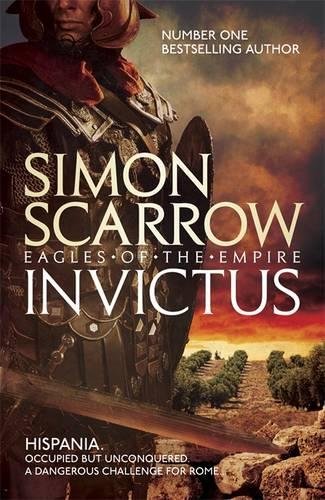
Book Review: Invictus

In Simon Scarrow's 15th novel of the Macro and Cato series, Invictus takes us to Roman-held Spain. I really enjoyed yet another exciting adventure. Scarrow's ability to create great scenes so the reader knows where they are is again evident throughout Invictus. And as always, Scarrow makes it easy to understand both the protagonist and antaganoists' point of view. I was surprised by Cato's sudden vicious turn. Being the intellectual of the two main characters, his new attitude did make me pause. 

All in all, Invictus is a good quick read.

Tuesday, May 30, 2017

Book Review: All The Light We Cannot See

All the Light We Cannot SeeAll the Light We Cannot See by Anthony Doerr

My rating: 4 of 5 stars


I was very impressed with Anthony Doerr's use of language. His description of the atmosphere of France and Germany before and during WWII was exceedingly vivid.

Telling the story primarily through the experiences of a German teenage boy, Werner, and a blind French teenage girl, Marie-Laure made for intriguing reading.

What I liked most about the Werner story, were the decisions he made to act or not act in certain situations. I also enjoyed Werner's process of learning there was so much more to the world than life in his small dirty coal town - even though it was not all positive.

Marie-Laure's story had great descriptions as they were filled primarily with the sense of touch, smell and hearing. Her listening to the sounds of her town after the initial bombing from birds to mollusks to dead whales was wonderful.

Unlike, Werner's story, hers had different perspectives from secondary characters like her father, uncle and von Rumpel. While this did not hurt the story, it made for a different reading in her chapters compared to Werner's.

There were time jumps every other chapter. Meaning the first chapter was 1944 while the second chapter was 1934 and the two stories ran forward from these two time points. I believe this was done to get some action into the beginning of the book, because while the 1934 years were mildly interesting, there was no sense of danger. It was a good choice.

Zach Appelman's reading on the Audiobook was superb.


View all my reviews

Sunday, April 30, 2017

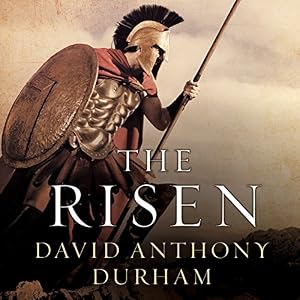
Book Review: The Risen

I enjoyed David Anthony Durham's telling of Spartacus' story from the perspective of multiple auxiliary characters from different tribes, Romans and slaves.

The Risen helped me understand the impressiveness of Spartacus' rebellion. Not only did he keep a winning army together for years in a hospitable land, it was an army of unprofessional solders where larger majorities couldn't communicate with each other as they couldn't speak each other's language.

I also liked that the novel started on the night of the breakout rather than on Spartacus' life prior to his capture and time as a gladiator. It really got the novel off to a fast start.

Steven Crossley gave a superb reading, breathing life into Durham's multitude of characters.

While there were many fully described battle scenes, I was a little disappointed that some battles were only talked about after they had happened.

Overall, I really enjoyed The Risen.


Saturday, August 22, 2015

Book Review: The Golem and the Jinni

The Golem and the Jinni by Helene Wecker is a fascinating story of Syrian and Jewish myths and cultures at the turn of the 20th century.

I admired Wecker's ability to draw a connection between the Jinni and Golem's cuffs and how humans are cuffed by religion, culture and money.

I enjoyed her descriptions of the world her characters inhabited and how the Golem and Jinni viewed our strange human behaviors providing moments of levity and self-reflection.

Narrator George Guidall's steady pace and accent provided an air of authenticity to the audiobook.

I would highly recommend this novel.

Amazon link to The Golem and the Jinni


Monday, July 2, 2012

Book Review: The Rising Tide

The Rising Tide by Jeff Shaara is the account of the war in North Africa and Sicily. The novel is told through the multiple perspectives of people who were there, including a tank gunner, a paratrooper, Eisenhower, Patton, and Rommel. Balancing these perspectives is a fair amount of narrative about the events happening surrounding these individuals, so the reader always has a good understanding of the larger picture.

This is one of the reasons why I like historical fiction: you learn something about history while you as a reader, experience it through the characters' eyes. The shock, then fear of the tank gunner who scores a direct hit on the turret of a massive German Tiger tank, that just keeps coming, and his subsequent race to escape. Afterwards, Shaara provides the reader with a narrative about the fullscope of the disaster at Kasserine Pass. This balance is what makes the story so engaging. Listening to the audiobook, my son would always say, "yes!" whenever we switched into the paratrooper or tank gunner's perspective, and lamented when we switched to Eisenhower's perspective or long bit of narrative, while I found all parts equally intriguing.

However, I found that this novel and Shaara's sequel, The Steel Wave, and even Pressfield's novel, Killing Rommel, only have Rommell's fictional view representing the German perspective of the battles and German command structure. In all three, Rommel constantly rails against the German high command, making them look inept. That may be true, but we don't read about anyone else's perspective to counterbalance or support his view. My son said he was voting for Rommel, because everyone was against him.

The Rising Tide and its reading by Paul Michael is a very engaging novel of the battle for North Africa and Sicily that I highly recommend.

Monday, January 9, 2012

Book Review: Under the Eagle

In 43 A.D., Rome launched it’s largest invasion of Britain consisting of roughly40,000 men. This is the setting of Simon Scarrow’s, Under The Eagle. Two legionnaires, a centurion and raw recruit, are our protagonists that will lead us into Britian.

I liked how Mr. Scarrow wove in his historical details without interrupting the flow of the novel. It lets the reader know that Mr. Scarrow knows his subject.

I also enjoyed the mystery that plays thoughout the novel. However, I think one of the reveals came too early. Also I think the ending could have been smoother. The resolution of the mystery and final action scene compete for the reader’s attention and suddenly the reader is unsure which event is the most important.

I enjoyed the novel and look forward to the second one, principally because I like the character of the centurion and have faith that Mr. Scarrow will be able to continue relaying the history of the invasion of Britain in an entertaining manner.

Wednesday, July 20, 2011

Book Review: The PIllars Of The Earth


I chose to read a novel by Ken Follet based solely on his reputation for writing critically acclaimed novels. I chose The Pillars Of The Earth because it is a historical novel about a period that I knew little about, 12th century England, and a subject I even knew less about, cathedral building and how English life centered around it.

This is not a fast-paced novel. It is 943 pages rich in details and language that takes you on a journey through a time where might was right, religion played an enormous part in everyone’s lives for good and bad, and showed a modern reader how tenuous one’s hold on life could be during that time.

My favorite chapter was the prologue. I had not read a chapter written in an entirely omnipresent point of view in a long time, and even longer for one done well. I actually read it twice, and even read it again to my son to show him how using details effectively can truly paint pictures in someone’s mind. Here is the opening line and first paragraph:

The small boys came early to the hanging.

It was still dark when the first three or four of them sidled out of the hovels, quiet as cats in their felt boots. A thin layer of fresh snow covered the little town like a new coat of paint, and theirs were the first footprints to blemish its perfect surface. They picked their way through the huddled wooden huts and along the streets of frozen mud to the silent marketplace, where the gallows stood waiting.


While I praise Follet’s writing for his use of details and language, be forewarned these details are used in every aspect of the book, whether it’s the building of the church, character descriptions, sex, murder, and rape.

While the first chapter is written in omnipresent, the rest is written in third person with alternating perspectives.

I enjoyed The Pillars Of The Earth, but it is very long and at times felt like it.

Monday, June 20, 2011

Historical Novel Society 2011 Convention

I had the great opportunity to attend the Historical Novel Society Conference in San Diego last weekend.

While the panels were interesting, what made the experience so fabulous was everyone being so friendly. No matter where I was, sitting at a meal, walking down a hallway or waiting outside the agent's pitching room, everyone was eager to engage in conversation. I heard fascinating stories about outlaws, princesses, kings, nuns, the arts, adventures, mysteries, romances, the Civil War, The War of the Roses, Ancient Egypt, Ancient Rome, the American West and so many more.

I also learned a lot about the business side of writing--especially the significant and unknown effect of e-books on the writing industry. Even though Bookscan isn't tallying e-book sales yet, there are indications that e-books now make up 30% of the market for books sold and for fiction up to 50%. During the final breakfast, I also had the opportunity to meet fellow members of the Los Angeles Chapter of the Historical Novel Society. And even though I had signed up late to the conference, meaning I had no scheduled agent pitch sessions, Kris did an amazing job in managing the no-shows allowing me to meet with three wonderful agents.

Thank you HNS for holding such a fun and interesting event.

Thursday, April 23, 2009

Book Review: City of Thieves


My favorite book so far this year. Yes, it even tops John Scalzi’s The Lost Colony which had been my favorite book this year until now. Why did it beat out Scalzi? Because Scalzi’s was the third book in a series, and City of Thieves introduced me to a whole new world and new set of characters. Now if I had to compare it to Scalzi’s Old Man’s War, the first book in that series…but I digress, this is a review about City of Thieves.

So, why did I enjoy City of Thieves so much?

Great characters. Great writing.

It reconfirmed my love of military historical fiction: put two well-written characters that play well off each other in a historical, war-time setting, and that time period comes alive better than it ever could in a history book.
There are two things I wanted to mention about Benioff’s style that put this book so high on my list.

First, his ability to bring forth moments of levity during the siege of Leningrad with all of its associated horrors still has me wondering how he did it so effectively. To show that people still joke or worry about the most inane things when the bloodiest struggle in history is raging all around them brought a sense of verisimilitude to the story. But don’t let me lead you on the incorrect assumption that this is a comedy. It’s a tragedy, as all wars are. Benioff doesn’t shy away from or gloss over the horrors of the siege or the war. It’s there, we see it, but Benioff relates it in a way that is told as though it is a story and not real. I don’t know else to explain it. There is something about Benioff’s writing that keeps us that half-inch away from what is happening, as though we are an up close observer, not a participant, even though we’re seeing it through the protagonist’s POV.

An example is the heart-wrenching story of Zoya versus the murder of a woman in The Dresden File.. Both were scenes were detailed in their description, but there was no space or filter between me and what I saw in The Dresden Files. The scene in The Dresden Files gave me a real nightmare. City of Thieves somehow gave the reader a respite, a bit of space. Like at a funeral for a distant cousin, you’re sad it happened and sad for everyone’s loss, but there is a sense of relief that you are a step removed from the grief of those closest to the departed.

The second comment on style I wanted to make was how well the sentences in City of Thieves flowed. How after a long paragraph, or short, or exchange of dialogue, I’d go wow that was really good. And then I’d have to go back and see how he did it. Part of it was Benioff’s expertise in constructing long sentences and stacking short ones.

For example:

“A few people had theories on where they could be found: high-ranking army officers had them flown in from Moscow; farmers outside the city gave them to the Germans, along with butter and fresh milk, in exchange for their lives; an old man who lived near the Narva Gate kept chickens in a rooftop coop.”

and

“It only took them a few hours. She hadn’t gotten far. She was so weak…She’d been little to begin with, and she ‘d barely eaten a thing since she’d been here. They brought her back.”

If you want to read a fun, slightly bizarre, adventure story about two soldiers during World War II who were ordered to find a dozen eggs in a starving city for a wedding cake, this is your book.

I highly recommend it.

Sunday, March 1, 2009

Book Review: The Killer Angels


Solid historical novel. It gave me a very good understanding of the motivations and rationale of the key generals at the Battle of Gettysburg. Sometimes motivations don't come across in a history book. But here, in a novel, Shaara was able to tell the reader why each man thought the decision he made was a good one, and if he followed a decision that he felt was bad, why he followed it.
The fight scenes themselves were taut, gripping and emotional: Buford's defense, Little Round Top, Pickett's charge.
Some of the introspection, which was great and provided so much insight into the characters, could get a little long.

The Killer Angels is a really good read if you have any interest in the Civil War.

Friday, November 7, 2008

Imperium


I just finished the historical novel, Imperium, by Robert Harris. It is the story of Cicero's rise to his first consulship, also known as Imperium, in 63 B.C. as told by his secretary Tiro. The novel is a fascinating read about Cicero's rise to power in the political hotbed that was Rome.

I normally need to see swords drawn and armies clashing to find a historical novel engaging, but through Harris' descriptive powers and being able to bring characters to life on the page, he was able to show just how exciting and lethal words and oratory could be.

One only has to look at our recent elections to see how effective an extremely good speaker can be in mobilizing the populace.

I highly recommend this book.

My only lament is that I wanted to see how the next twenty years of Cicero's life played out.

Needless to say I read about it on Wikipedia before I wrote this blog.

I really hope Harris will write a sequel to the rest of Cicero's amazing life.

Wednesday, April 16, 2008

Pompeii

I finally finished reading Pompeii by Robert Harris. I say finally, because it took me almost a month to finish it.

The first hundred pages were loaded with great details, but so many that I found myself skimming. The lack of connection with any of the main characters in the first third of the story was my principal problem and allowed me to set the novel aside and read something else to often. But then the next two hundred pages blew me away. (No pun intended.)

It wasn't the protagonist who saved the story, but the antagonist and how he impacted/influenced those around him. And whether it just took me awhile to get used to Harris' writing style or finally feeling for his characters, his excessive attention to details really served him well once Vesuvius blew its top.

I'm extremely glad I didn't put the novel down for good before I finished the first third of the book. But man, was I close.